Silken and firm are not two points on a softness scale. They are made by different processes, and that is why swapping one for the other does not go slightly wrong, it goes completely wrong. A block of firm tofu will never blend into a smooth cream no matter how long you run the blender, and silken will never brown in a pan no matter how hot it is.
Once you know what the label is actually describing, choosing is easy.
| Type | Use it for | Avoid it for |
|---|---|---|
| Silken | Blending into sauces and desserts, dropping into soup, spooning cold | Frying, pressing, anything stirred hard |
| Soft or medium | Scrambles and gentle simmering, where a loose curd is the point | Any dish that needs a cube to survive to the plate |
| Firm | Pan-frying, marinating, baking, skewers. The default block | Blending smooth, where it turns grainy |
| Extra-firm | Tearing, grating, and anything the block gets handled a lot | Dishes where softness is the texture you came for |
What actually makes them different
All tofu starts the same way: soy milk plus a coagulant, which turns it into curds and whey exactly as it would with dairy. What happens next is the whole difference.
For firm tofu, the curds are separated and pressed. Pressing squeezes out whey, and the harder and longer it is pressed, the less water is left and the tighter the remaining protein network becomes. Firm and extra-firm are the same product at two points on that press.
Silken is not pressed at all. The soy milk is coagulated in its final container and sets there, like a custard in a ramekin, so no whey is ever drained and no curd structure is ever formed. That is why it is smooth rather than grainy, and why it has the most water of any tofu by a distance.
Everything below follows from those two facts.
Silken tofu
Because it never formed curds, silken blends into something genuinely creamy rather than merely smooth. That is why it turns up in desserts: Vegan Chocolate Mousse leans on it entirely, and Roasted Miso Cabbage with Whipped Tofu uses it to get a whipped texture that firm tofu cannot reach.
It also holds together surprisingly well as long as nothing pushes it around. The Korean-Inspired Tofu Bowl lowers the cubes into the marinade rather than stirring them through it, and that is not fussiness. Stirring is the specific thing that breaks silken.
One practical tell: shelf-stable cartons on a supermarket shelf are almost always silken, because coagulating in a sealed aseptic pack is exactly how that product is made. Firm tofu sits in the chiller in water. If it is in the cupboard aisle, expect silken, and see how long does tofu keep for what changes the moment you open it.


Firm tofu
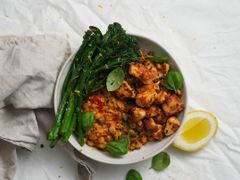
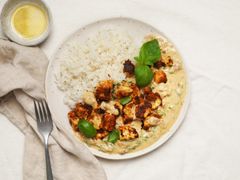
The default, and the block nearly every fried-tofu recipe means when it just says "tofu". It takes a marinade, holds a cube, and browns properly once some water is out of it, which is what Marry Me Tofu and Tofu Tikka Masala both rely on.
Browning is worth understanding, because it explains the entire silken and firm divide in the pan. A surface cannot get past the boiling point of water until the water on it has gone. A wet block puts out steam faster than the pan can drive it off, so the surface sits at 100C and stays pale no matter how long you leave it. Get the water down and the surface can climb past that point, and only then does it brown. Firm tofu starts closer to that line, and pressing takes it the rest of the way. The full method is in how long to press tofu.
The flip side: firm tofu blended smooth goes grainy, and no amount of blending fixes it. The pressed curd structure is precisely what the blade cannot fully break down.


Extra-firm tofu
Firm tofu with more water pressed out. Buy it when the recipe tears, grates, skewers or otherwise manhandles the block, because those are the moments a softer block falls apart.
It is not automatically the better choice. Less water means less room for a marinade to move in, so a block that starts drier takes on flavour more slowly. For anything sitting in a marinade overnight, firm is often the smarter buy.
Blending: where the choice shows up most
This is where the difference is least forgiving, because smooth is the entire product and there is nothing else for the texture to hide behind.
Whichever block you start from, run the blender longer than feels necessary. Vegan Poppy Seed Cheesecake and Vegan Tofu Cheesecake with Strawberry Curd both call for a full two minutes, specifically so the cream sets without tofu grit in it. The second squeezes the water out first, which is the other half of the same problem: a wet block thins the mixture and it never sets firm.
Vegan Quilted Blanket Cake with Tofu Curd crumbles the block before it goes in, which gets there faster because the blade has less structure left to break down.


When a recipe lets you choose
Some dishes genuinely work either way, and the good ones tell you what you are choosing rather than just listing an alternative.
Vegan Tofu Scramble offers both: silken in larger cubes for something soft and custardy, or firm crumbled small for something drier and closer to scrambled egg. Japanese Braised Tofu says much the same, that silken makes it softer.
That is the useful way to hold all of this. The type is not right or wrong. It decides what you get, and once you know which process made the block in your hand, you already know what it will do in the pan.