Tempeh and tofu both start as soybeans, and that is about where the resemblance ends. Tempeh keeps the whole bean and is held together by a mould. Tofu throws the bean away and keeps only its milk. That one difference explains the protein numbers, the taste, why one needs pressing and the other never does, and which of them belongs in tonight's pan.
| Compared | Tempeh | Tofu |
|---|---|---|
| Made from | Whole cooked soybeans, fermented into a firm cake | Soy milk, curdled and usually pressed into a block |
| Protein per 100 g | About 19 to 20 g | About 12 to 17 g for firm, 5 to 7 g for silken |
| Taste | Nutty and earthy, sometimes with a faint bitter edge | Almost none until you give it some |
| Texture | Dense and chewy, breaks apart by hand | Anything from custard-soft to very firm, depending on the press |
| Pressing | Never needed | Usually, for anything fried or baked |
| Best for | Crisp little cubes, thin slices, crumbles that hold | Soaking up marinade and broth, frying, blending smooth |
| Opened, in the fridge | 3 to 5 days, wrapped tightly | 3 to 4 days, under fresh water changed daily |
| Gluten | None in plain soy tempeh. Grain blends can contain it | None in plain tofu |
Which has more protein, tempeh or tofu?
Tempeh, per gram, and the reason is mostly water. Firm tofu is a pressed curd that still holds a lot of the liquid it set in, and that water weighs something without carrying any protein. Tempeh is beans with very little free water, so 100 g of it is mostly bean. The spread inside tofu has the same cause: silken was never pressed and sits at the bottom of the range, extra-firm was pressed hardest and sits at the top. The full story of that press is in silken vs firm tofu.
Count by calories instead of grams and the gap mostly closes. Tempeh carries roughly 190 kcal per 100 g against about 145 for firm tofu, so per calorie the two deliver close to the same protein. If what you are tracking is protein for the energy you eat, neither is the obvious winner. If it is protein per bite, tempeh is.
Two smaller differences go to tempeh. Because it keeps the whole bean, it keeps the bean's fibre, while tofu loses most of it when the pulp is strained away to make soy milk. And because both come from soy, both carry every essential amino acid, so "complete protein" is true of either. For how much of it ends up on a plate, see getting enough protein without meat.
Brands vary more than these ranges suggest, especially for tofu, so the label on the pack beats any table, this one included.
What does tempeh taste like next to tofu?
Tofu tastes of very little on purpose. It is a mild curd built to take on whatever it sits in, which is exactly why plain tofu disappoints people and why tofu that tastes like nothing has a fix rather than a verdict.
Tempeh arrives with a flavour of its own. The fermentation that binds the beans also makes it nutty and a little mushroomy, and some blocks have a faint bitter edge. If that edge bothers you, a few minutes of simmering before it goes into a marinade softens it.
Smoked tempeh goes further and turns up already seasoned all the way through, which is why most of our tempeh recipes ask for the smoked kind. It is the closest thing in a vegan fridge to bacon that needs no work.
Why tempeh never needs pressing
Pressing tofu is about getting water out so the surface can brown, and how to press tofu is a whole guide because tofu has so much of it. Tempeh has almost nothing to give. It is a cake of beans knitted together by white mould threads, with no free water to squeeze, so it goes from the pack to the knife to the pan.
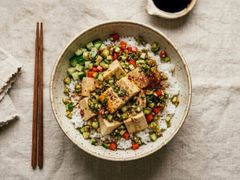
Marinated Tempeh Bowl with Peanut Sauce shows how short that path is. The tempeh is cut, tossed in a soy and ginger marinade for at least 30 minutes, then baked for about 25, flipped halfway so it colours on every side. No towel, no weight, no waiting.

Where tempeh beats tofu
Anything that should end up crisp in small pieces. Browning cannot start until a surface has dried, and tempeh starts out nearly dry, so diced small and fried it goes golden and crunchy quickly. Pierogi with Bryndza Filling and Dill fries smoked tempeh cubes for about 10 minutes until crisp, then uses them both inside the dumplings and scattered on top. Vegan Cacio e Pepe Spaghetti chops it finely and fries it into a crisp "bacon" for the top of the pasta.
Slices that have to survive. Tempeh holds a thin cut that would tear in tofu, which is why Vegan French Potato Gratin slices it as thin as the potatoes and layers the two.
And crumbles with some bite. Tempeh with Tahini Sauce and Udon Noodles breaks the block up by hand and sautés it for 3 to 4 minutes. Crumbled tofu at that point would still be soft.


Where tofu beats tempeh
Anything creamy. Silken tofu blends into a smooth cream because it never formed curd, and tempeh, being whole beans, can only ever become a coarse paste.
Anything that should soak up a liquid. Tofu is mild and porous, so it takes on the flavour of whatever it sits in, given time. Japanese Braised Tofu with Rice simmers the block in broth for at least 20 minutes, then leaves it to rest in the broth for another 20, because the resting is when it drinks the most.
And anything soft on purpose, from a scramble to cubes floating in soup. Tempeh has one texture, and it is firm.

Can you swap tempeh and tofu?
When the job is a crisp topping, yes, and our own recipes say so. Vegan Slovak Dumplings with Sheep Cheese and Tempeh and Pasta with Roasted Hokkaido Pumpkin Sauce both let you fry tempeh or tofu into small pieces for the top. Use firm tofu, press it first so it crisps rather than steams, and expect a milder result than smoked tempeh gives.
Going the other way works less often. Tempeh will stand in for firm tofu in a stir-fry or a bowl, but nothing about it can replace silken in a cream, and in a braise it stays firm and nutty instead of turning soft and soaked.


How long does tempeh last in the fridge?
Unopened, until the date on the pack, kept in the fridge. Opened, wrap it tightly and use it within 3 to 5 days. Cooked, 3 to 4 days in an airtight container, the same as any leftovers.
It freezes better than tofu. Freezing tofu turns its water into ice crystals that tear the curd and leave it spongy, which how long tofu lasts in the fridge covers. Tempeh has so little water that it comes out of the freezer close to how it went in. Wrapped well, it keeps about three months there at its best.
How to tell if tempeh has gone off
Some of what looks alarming is normal. The white fuzz holding the beans together is the mould that made it, and small grey or black patches, often around the little holes in the pack, are that same mould maturing.
Throw it out if it feels slimy, if you see pink, yellow or blue-green growth, or if it smells sharply of ammonia or sour rather than of mushrooms. Those mean something other than the tempeh mould has moved in.