The protein question follows plant-based eating around more than any other, and it is usually answered with a list of ingredients rather than a number. That is the wrong shape of answer. Nobody eats 100g of raw tofu, and knowing that lentils "have protein" tells you nothing about whether dinner got you there.
So here it is as plated portions instead, computed from what our recipes actually contain rather than from a table of raw ingredients.
The numbers, from actual recipes
Of the 100 recipes published here, 57 carry 20g of protein or more per serving, and 20 carry over 40g. Not per 100g of a raw ingredient, but per plated portion, computed from what the recipe actually contains.
| Protein / serving | Recipe |
|---|---|
| 60g | Mediterranean Chickpea Ragù with Crispy Tofu |
| 55g | Marry Me Tofu in Creamy Tuscan Sauce |
| 55g | Mapo Tofu Udon |
| 52g | Tofu Skewers with Peanut Sauce |
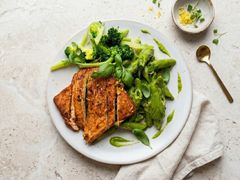
| 49g | Tofu 'Chicken' with Spinach Sauce |
| 48g | Tofu Gyros Wrap with Curry Dressing |
That is the honest answer to "can you get enough protein": a single dinner can carry most of a day's requirement.


Why the plated number is the only one worth quoting
Ingredient tables are quoted per 100g, and almost nothing is eaten in 100g units. A recipe that "contains lentils" might carry 9g of protein or 35g depending on how many went in and how many people it feeds, and the ingredient list cannot tell you which.
That is why every figure here is per serving as the recipe defines it. It is a less flattering number than the raw one and a far more useful one.
Where it comes from
Four sources do nearly all the work:
- Tofu and tempeh: roughly 8 to 19g per 100g depending on firmness. Extra-firm is denser, so it is higher, and the difference is simply that more water has been pressed out of the same amount of protein. Tempeh is higher again because the whole bean is used rather than the strained milk.
- Legumes: chickpeas and black beans around 9g per 100g cooked, lentils similar and cheaper. The cooked figure is the one that matters and it is roughly a third of the dried number, which is where most confusion about legume protein starts. Mung Bean Dhal builds a whole meal on a bag of dried mung beans and store-cupboard spices.
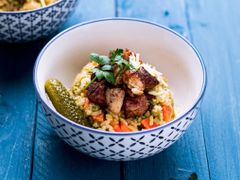
- Soy chunks and TVP: the highest of all by dry weight, because they are defatted soy flour with the water taken out, so what remains is close to pure protein until you rehydrate it. That is also why they are the cheapest protein in the shop by a wide margin, which is why our Slovak-Style Rice with Soy Chunks reaches 40g a serving on a budget. The same dried chunks carry Vegan Stroganoff with Pasta and "Chicken" Pot Pie, both of which soak them before cooking (salted water in one, hot broth in the other), because dried soy rehydrated in plain water tastes of plain water. Vegan Čevapčiči goes a step further and kneads vital wheat gluten into the soaked granules, which is what makes the mixture hold together like a sausage.
- Nuts, seeds and peanut butter: expensive per gram, but they raise a dish that is otherwise carbohydrate. Peanut Curry Udon Noodles with Tofu stacks both, putting the peanut sauce on a noodle dish that would otherwise be almost entirely starch.


Breakfast is where it goes missing
Lunch and dinner tend to look after themselves. Breakfast is usually toast.
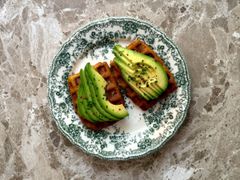
Ours sit at 15 to 20g: Vegan Egg Spread with Chives at 15g in ten minutes, Vegan Radish Spread at 20g in fifteen, and Tofu Waffles at 37g, which is more than most people's dinner.


Breakfast, and why it is the one to fix
If a day comes up short, breakfast is almost always where it happened. Lunch and dinner are built around a main component, and that component usually carries protein whether you planned it or not. Breakfast is built around bread.
The fix is not a protein powder. It is treating breakfast like the other two meals and giving it a component. Vegan Egg Spread with Chives gets to 15g in ten minutes because there is tofu in it rather than only bread under it. Tofu Waffles reach 37g, which is more than many people's dinner, from the same move.
The complete-protein question
You do not need to combine proteins at every meal. That idea came from a 1970s book and its author later withdrew it, but it outlived the retraction by decades and still turns up in otherwise sensible articles.
What is true underneath it: different plants are short of different essential amino acids, so no single one is ideally balanced on its own. What does not follow is that they have to arrive in the same bowl. The body holds a pool of free amino acids and draws on it across the day, so eating varied over a day does the combining for you. Soy, quinoa and buckwheat are complete on their own anyway, and soy is in most of what is above.
How much you actually need
Roughly 0.8g per kilo of body weight a day is the general recommendation, so about 56g for a 70kg person. Training seriously pushes that up, commonly to between 1.2 and 2.0g per kilo depending on what the training is.
Look back at the table with that in mind. One dinner at 55g is most of a sedentary day's requirement, and the reason plant-based protein feels difficult is rarely that the food lacks it. It is that a day of toast, salad and pasta can genuinely come to 30g without anyone noticing, and no single meal in it was obviously wrong.