Dairy is forgiving because it is standardised. Whipping cream is roughly the same from one shop to the next, so a recipe that says "cream" means one thing. Plant-based versions are built from soy, oat, coconut, nuts or blended fats, each thickened in its own way, and two cartons with the same word on the front can behave like different ingredients.
That is why a recipe can work perfectly once and fail the next time with a different carton. You didn't do anything wrong. The product changed. The fix is to stop shopping by name and start reading two lines on the back: the fat per 100 g, which is simply the fat percentage, and the first few ingredients.
| Product | What to check | Where it goes wrong |
|---|---|---|
| Cooking cream | Labelled for cooking. Oat is the safer base for acidic sauces | A soy cream boiled hard with tomato or wine can curdle |
| Whipping cream | Sold as whippable, or canned coconut cream at full fat | Warm cream, or a pouring cream, will not hold air |
| Sour cream | A thick one, ideally thickened with starch or coconut fat | Boiled in a sauce, it thins out or separates |
| Cream cheese | Mostly coconut oil, so it is firm only while cold | A cheesecake made from it slumps at room temperature |
| Butter for baking | A firm block, around 80% fat, not a soft tub | Spreads carry extra water, so pastry turns greasy and flat |
| Milk for baking | Unsweetened soy, for its protein | Almond or rice milk gives a paler, more crumbly bake |
| Grated cheese | Melts only with moisture and cover | Left dry and exposed it goes hard or oily |
Cooking cream in a hot sauce
Most plant cooking creams are soy, oat or coconut, and the difference shows up the moment they meet heat and acid. Soy is the one to watch. Soy protein clumps when it gets hot in an acidic liquid, which is exactly how tofu is made: heat soy milk, add a coagulant, and curds form. A soy cream poured into a bubbling tomato sauce with a splash of wine is a small, accidental version of the same thing.
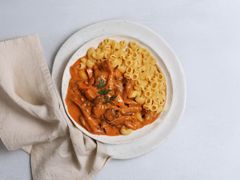
You don't need to avoid soy cream. You need to treat it gently. Let the acidic part cook first, turn the heat down to a low simmer before the cream goes in, and keep it from boiling hard afterwards. Penne alla Vodka is the classic test: a tomato base, a splash of vodka, and plant-based cream stirred into both.
Oat-based creams carry much less protein than soy, so there is less to clump. They tend to thicken rather than split, which suits a long bake like Vegan French Potato Gratin. Coconut cream is the most heat-stable of the three because it is mostly fat, but it tastes of coconut. Whether that matters is a question for the dish, covered in creamy vegan sauces.


Why some creams won't whip
Whipping works when fat is partly solid. The cold, firm droplets cluster around the air you beat in and hold it there. Liquid fat cannot do that, so warm cream or a thin pouring cream just gets frothy and collapses. Dairy cream needs around 30% fat before it will whip at all.
Plant whipping creams get there with fats that are solid when cold, usually coconut or palm kernel. So keep the carton in the fridge, chill the bowl, and stop as soon as it holds soft peaks. Past that point the fat clumps into grains and you are on the way to butter.
Canned coconut milk works if it is full fat. Chill the can overnight, open it without shaking, and scoop off the solid layer on top. Light coconut milk does not have enough fat to whip, however long you beat it. Black Forest Cake adds a whipped cream stabiliser as well, because the cream has to hold its shape between sponge layers for hours, not just on a plate for a few minutes. Waffles with Whipped Cream only needs it to last until you eat it.


Sour cream and yogurt
Vegan sour cream is usually a plant base thickened with starch, gums or coconut fat, then soured. That structure is fine cold and fragile hot. Stir it into a goulash or stroganoff at the end, on low heat, rather than letting it boil in the pot. Vegan Szeged Goulash adds its soy yogurt only after the cooking is done.
Cold, it needs no care at all, which is why it works as a topping on Lángos.
In baking, sour cream brings acid as well as fat. The acid reacts with baking soda and the fat keeps the crumb tender. Thickness is what varies between products, and a runnier one is carrying more water. Lemon Loaf Cake with Glaze takes coconut yogurt or sour cream, because a loaf cake is tolerant. A cheesecake is not. Baked Vanilla Cheesecake Loaf asks for a thicker cream with around 30% fat, and says you can use slightly less cream and make up the difference with coconut yogurt. That's the kind of swap that works, because it keeps the batter thick.


Vegan cream cheese, and why cheesecakes slump
Most store-bought vegan cream cheese is coconut oil, starch and water. It is firm straight from the fridge because coconut oil is solid when cold, and it softens quickly once it warms up, since coconut oil melts at about 24°C. A cheesecake built mostly on it holds its shape only because it is cold. Leave a slice out for half an hour and it starts to sag.
That is why Vegan Poppy Seed Cheesecake starts from tofu instead. Tofu brings protein, cornstarch sets as it bakes, and the result is set rather than just chilled. It still needs time in the fridge, overnight ideally, at least two hours, but it stays a slice when it comes out.

Butter for pastry and cakes
This is where the label helps most. In the EU and UK, a product can only be sold as margarine if it is at least 80% fat. Anything lower has to say so on the pack, as a spread or a reduced-fat margarine, and it makes up the difference with water. Elsewhere, read the fat per 100 g. A baking block sits around 75 to 80%. A soft tub is often well below that, and some are whipped with air to make them spread.
For flaky pastry the fat has to stay in pieces. Cold lumps of fat sit between layers of dough, and in the oven their water turns to steam and pushes the layers apart. Classic Vegan Cherry Pie asks for pieces about the size of half a walnut, and Vegan Apple Cinnamon Galette for pea-sized ones, both from chilled butter. A soft spread smears into the flour instead of staying in lumps, so the pastry bakes greasy and flat.
Cakes are more forgiving, but a high-water spread still makes a wetter, denser crumb. Use the block for baking and keep the tub for toast.


Plant milk in baking
Protein is what separates the milks here. Soy milk has roughly as much protein as cow's milk. Oat and almond have well under a third of that. In a cake or a muffin, protein helps the crumb hold together and brown, which is why Vegan Chocolate Blueberry Muffins and Vegan Crepes both use soy.
Buy it unsweetened and unflavoured. Vanilla or sweetened milk adds sugar the recipe did not count, which shows up as a darker crust and a sweeter bake.
Soy's protein also makes a quick buttermilk. Stir in some vinegar and within a couple of minutes it curdles slightly and thickens, which is the first step in the waffle batter for Waffles with Whipped Cream. Oat and almond milk barely thicken, because there is not enough protein to clump.


Vegan cheese that won't melt
Dairy cheese melts and stretches because of casein, a milk protein that plant cheese does not have. Most vegan cheese melts through coconut oil and starch instead, and starch only softens when it has water to absorb. Sprinkled on a dry surface under a hot grill, it stays in shreds, then goes hard or oily.
Give it moisture and cover. A bake like Vegan Eggplant Lasagne is the easy case, because the cheese sits on wet sauce with steam rising through it. On a drier dish, cover it with foil for the first part of the bake and uncover it at the end to colour. Nut-based soft cheeses are a different product again: they soften and spread, but they won't melt, so use them where you want them cold or barely warm.

When it has already gone wrong
A sauce that has split into small curds can often be rescued with a stick blender. The curds are fine protein, and blending pushes them back into a smooth sauce. Take it off the heat first, and don't let it boil again afterwards.
Whipped cream that has turned grainy has gone too far, and you can't undo it. Fold in a few spoonfuls of unwhipped cream to loosen it, and next time stop at soft peaks.
If pastry baked flat and greasy, the fat was either a soft spread or warm when it went in. Check the fat on the pack before you blame your hands. If a cheesecake won't hold a slice, it needed more time in the fridge, or less of a coconut-oil cream cheese. Either way, the label is where to look first.